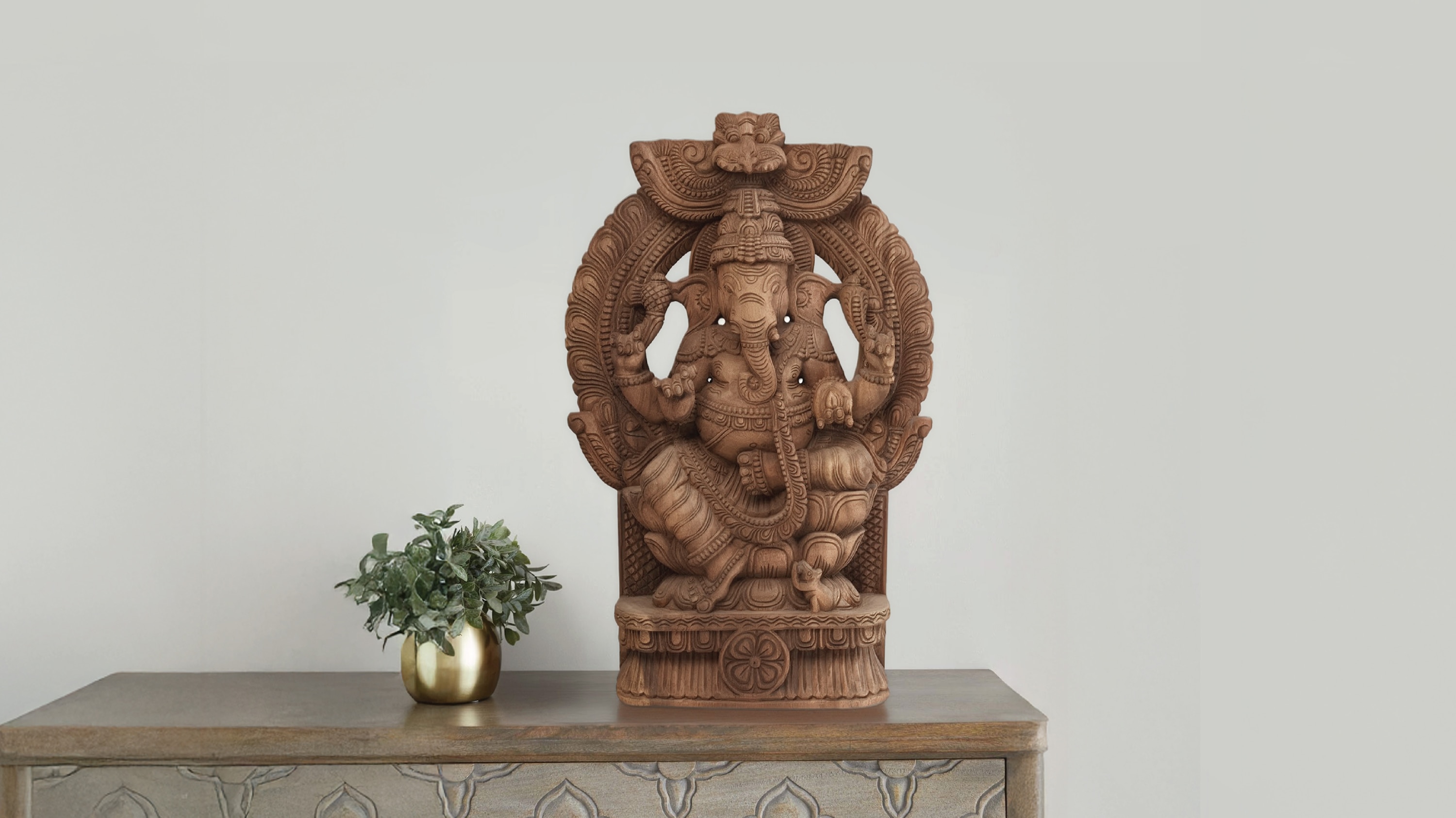
Most of us have chosen something for our desk that speaks entirely to the person doing the work. A Ganesha at one corner. A painting within eye line. A plant. A coaster made by hand. In India, the instinct behind these choices is older than any desk. Vastu Shastra has named it for centuries.

The Desk as a Vastu Space

In Vastu Shastra, the workspace calls for orientation on two levels: the physical arrangement of the room and the quality of intention behind what is placed within it. The direction you face when you work in a home office, the objects within reach, what occupies the wall at eye level: each carries weight in this tradition. Choosing handcrafted objects for a desk, in this light, is an act of placement as deliberate as dressing any other surface in the home.

Ganesha at the Desk

Ganesha arrives first on almost every desk. The deity of beginnings and of the clearing of obstacles, he belongs, in the Vastu tradition, at every threshold entered with care, and the desk is one. A Dhokra Ganesha from Chhattisgarh or West Bengal is shaped by the lost-wax method, a casting technique whose origins in the subcontinent predate written record. The result is an immediate, textured presence on a working surface. A bronze casting from the South Indian tradition brings a different quality to the same form: the formal gravity of a craft tradition measured in centuries of temple use.

What Holds the Eye Between Tasks

The wall above the desk is where a miniature painting belongs. The Rajasthani miniature tradition, worked in natural pigments on wasli paper by craftsmen trained in a lineage that reaches to the Mughal courts, produces paintings detailed enough to reward a second look and a third. A botanical study, a court scene, a devotional image: small in scale and inexhaustible in content. Vastu associates the north and east with clarity and the flow of knowledge; a painting placed here honours both.

What the Hand Returns to

A bookend in marble carving from Rajasthan or carved stone from Odisha gives the desk its anchor, the sense of a surface that someone has taken time over. A coaster in Tarkashi, the wire inlay craft of Rajasthan whose artisans press fine metal wire into wood in geometric patterns that take shape over hours, brings that quality to the most handled point on the desk: an object picked up many times a day, bearing its tradition in every use.

Stone, Geometry and the Auspicious Object

The Shri Yantra, nine interlocking triangles forming one of the most precise geometric constructions in Indian sacred tradition, holds the wish for abundance and clarity in the space where work is done. Associated with Lakshmi and the Shri Vidya tradition, it belongs on a desk as naturally as a Ganesha. A Shri Yantra carved in stone from Jaipur's centuries-old stone carving tradition brings both the form and the craft together: sacred geometry held in a material that has been worked with intention for generations.

The Khambati agate occupies the desk differently. Quieter. More mineral. Khambhat in Gujarat is one of India's oldest stone-working centres, its agate carving tradition documented from the Indus Valley period. The stones are sourced locally, shaped and polished by hand by artisans whose craft supplied the Mughal courts. Before that, Khambhat agate travelled on ancient trading routes from Gujarat to Mesopotamia. A piece from Khambhat wears that lineage in its surface: the depth of colour, the particular translucence that only hand-polished stone achieves.

The Living Thing on the Desk

The plant arrives last and holds its place longest. A hand-thrown terracotta planter or a blue pottery piece from Jaipur brings what Vastu calls Prithvi, the earth element, into the workspace: the grounding quality that steadies everything arranged above it. A desk with a living thing on it is a desk that reads as someone's.

In Vastu, the place of work is a space with its own gravity. A desk tended this way holds that gravity in every object on its surface.