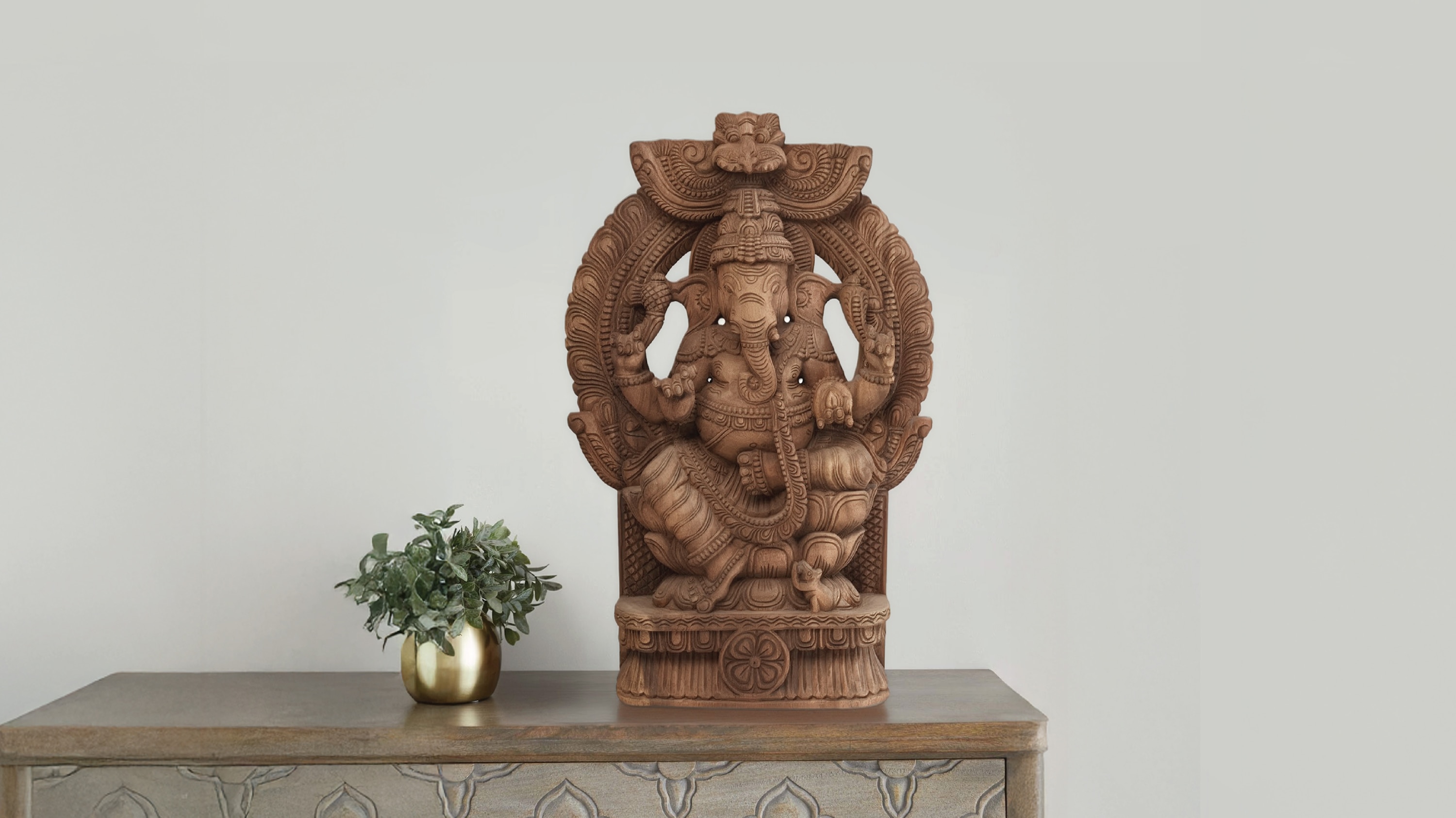
In the Panchtatva framework, Akasha is first. In the home, it is what everything else is organised around.

The Centre That Was Kept Open

In the classical Indian home, the centre was kept open. The Brahmasthana was unroofed, unbuilt, open to sky. The Indian home built around its centre, not toward it. The empty heart was the point. The space that building was organised around, not the space that remained after it.

What the classical builder understood, the contemporary home can still practice. The shelf with one object and nothing beside it. The corner given room to exist. The corridor where a single form stands and the wall behind it is bare. These spaces are Akasha, protected.

The Art of Placement

A Shilabalika in stone at the turn of a corridor, the wall behind it bare and the floor around it clear. The eye finds it and stays. In a home full of guests, it is the first thing anyone asks about. In a foyer styled this way, the sculpture is not one element among many. It is the room's entire first impression, confident enough to carry that weight alone.

A Shalabhanjika placed on a console, nothing beside it. A floor vase at the end of a long wall where afternoon light pools. A Prabhavali wall accent above a foyer table, the surface below it deliberately open. Each of these is a placement decision first, a décor one second. The restraint is the style.

What they share is an understanding of space as the point, not the background. Each one is complete enough that nothing needs to stand beside it.

Something in it carries. Something lingers after the eye has moved on.

A Final Thought

Of all the elements, Akasha alone cannot be brought in. It can only be preserved.