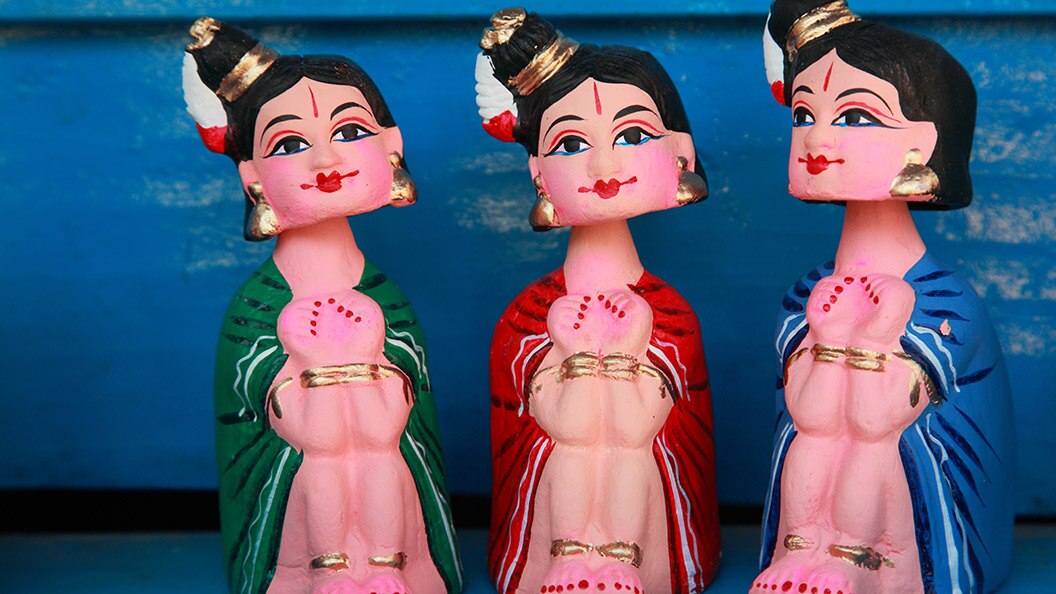
Bobble head dolls for life lessons
The bobble-head dolls of Thanjavur are part of stories and metaphors, art and craft of the state of Tamil Nadu. The Uruttu bommai (king and queen) figures and talai aati bommai (dancing dolls) are the most popular. They also come as representations of Hindu deities, mythological characters, literary figures and Thanjavur dynasties. Dance forms such as Kathakali and Manipuri are also depicted by them. These dolls are an integral part of ceremonies like Kolu and Dussehra.
The Making
Gold leaf, precious stones and beadwork adorn these painted hand-made dolls. The crafting process starts with creating a dish-shaped clay base. Moulds made from Plaster of Paris (POP) are used to form the body parts. Once dry, they are assembled using cement and POP. A slurry mixture of POP is applied to the doll before painting to give it a shiny finish. Details like clothing, accessories and facial expressions are painted on with natural and artificial colours. Different-sized brushes are used, with red soil being one of the materials used for colouring the base. When tapped, these dolls gently sway in a continuous dance-like movement without any strings or springs. Slowly, they return to an upright position because of their heavy clay base, showing excellent balance with gravity.
The Legacy
The origin of Thanjavur dolls can be traced back to the 19th century, during the reign of the Maratha King Serfoji. Back then, around 500 artisans were involved in crafting these dancing dolls. Today, this craft is kept alive by no more than two dozen families. The Thanjavur doll tradition was certified with a Geographical Indication (GI) tag in 2008.
Memory Vault
A group of doctoral students brought Thanjavur doll artistry to life, in an eight-minute animated short film in which the doll appears to do Bharatanatyam through motion capture.
Featured
More from India