The Sari as a Master Story Teller
The Paithani, a handwoven sari from Maharashtra’s Aurangabad district, has a glorious history, spanning two millennia across three ruling dynasties — the Satvahanas, Yadavs and Marathas. Interestingly, the sari’s weaving technique comes closest to the Kani of Kashmir. Visually, Paithani embraces vivid hues, decorative gold borders and a pallu with floral and architectural motifs, especially the munia (the parrot). The textile tradition is seen across Yeola in Maharashtra, plus Chanderi, Patan, Varanasi and Narayanpet.
The Making
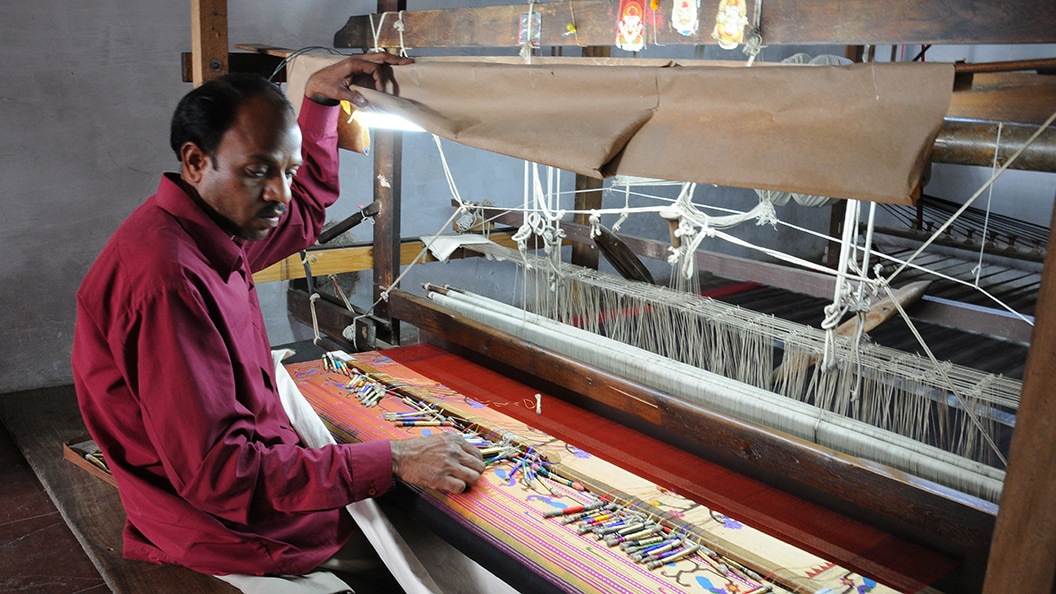
The body of the sari is handwoven on pit looms without the use of extra weft-forming figures. The pallu and border are woven using tapestry weaving techniques, dove-tailing, and double-interlocking methods. Paithani weaving is long, slow, and requires considerable dexterity. It can take weeks and even months to complete even a contemporary sari, which is then adorned with peacock, lotus, swans, and features from ancient architecture that still stands in Paithan. Yeola, located near Nashik, is currently a commercial hub for contemporary Paithani saris.
The Legacy
Paithan (once known as Pratisthan) is an ancient town located on the north bank of the Godavari River. It was the capital of the erstwhile Satavahana Kingdom. The name of the town gives the weaving style its name. The use of a unique double-interlock tapestry weaving in Central, South and West India became known as the Paithani. It became the top choice for bridal and festival wear by Hindu Maharashtrian women, who wear it as the nine-yard sari. During the Peshwa as well as the Mughal rule, men also wore Paithani patkas or waist sashes. The Deccan rulers patronised Paithani in the early 17th century. They would commission cotton, silk, and metallic yarns with golden borders. The motifs would include geometrical motifs or those of birds and flowers.
Memory Vault
In October 2023, an exhibition titled Kath Padar: Paithani and Beyond was held in Paithan. TVAM Foundation arranged the exhibition at the Shri Balasaheb Patil Government Museum, which brought together the first-ever such display of historical Paithanis from state-run museums in Maharashtra, as well as private collections. The programme was to inform, educate, and sensitise local viewers and weavers about the tapestry weaving. Visitors learnt of its historical legacy, that moves from archaeology to politics inside royal households and the persistence of gold yarn from the 17th to 19th centuries.
Featured
More from India